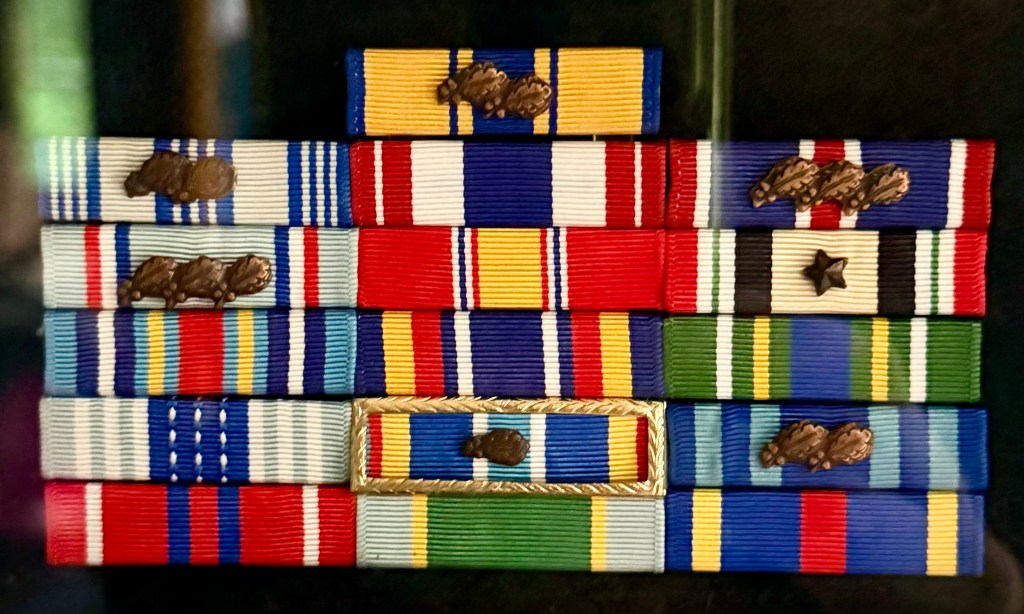
My military career has been hanging on my wall this whole time.
Not all of it, obviously. Almost thirteen years of my life couldn’t possibly fit inside a shadow box. But there are pieces of it in there. My dog tags, my Security Forces badge, my beret, my rank, and a ribbon rack with five complete rows and a sixth started.
I’ve had that shadow box for years, and recently I decided to take a closer look at my ribbons. I knew I’d earned them, obviously, but I wanted to revisit what each one represented.
Well, that turned into quite the project.
I started pulling out my military records, looking through old evaluations, awards, assignments, and deployments. Some things I remembered perfectly. Other things I’d forgotten about entirely. And then there were things I started learning about places I’d been that weren’t necessarily known when I was there.
What I wasn’t expecting was how much I’d find myself thinking about the life happening outside those records.
Because I knew I’d done a lot in the military. That wasn’t some new discovery. I was there, after all. But having everything documented in front of me was interesting, especially when I started remembering what was actually happening while I was earning those awards.
And my ribbon rack was apparently impressive long before I started looking into it.
I remember being an E-4 at Airman Leadership School and having E-6 and E-7 instructors decide there was absolutely no way all those ribbons belonged to me.
They thought I was wearing a fraudulent rack.
I’m not kidding.
I actually had to carry an official printout of my military record in my pocket to prove I’d earned them.
Imagine that. You’re attending a school that’s supposed to develop military leaders, and the people teaching it have already decided you’re lying because your accomplishments don’t fit what they think someone your age and rank should have done.
That pissed me off.
And it told me quite a bit about the instructors standing in front of me.
They didn’t ask to understand. They’d already made up their minds.
But here’s the interesting part. By the end of ALS, those same instructors thanked me and told me they’d never dealt with a strong woman like me before.
I wonder if they ever considered what that said about them.
Anyway, that wasn’t the first time I’d been given responsibilities that were apparently unusual for someone my rank. That started almost immediately.
I joined the Air Force in 2001 and became Security Forces.
A cop.
Although Security Forces covers quite a bit more than what people typically imagine when they hear the word cop.
I was still in technical school when September 11 happened. So I entered the military in one world and started my career in another.
I was nineteen when I arrived at Barksdale Air Force Base in Louisiana.
One of my first assignments was working Entry Control at what was then the largest Weapons Storage Area in the Department of Defense.
I was an E-2.
The position was normally held by an E-4 or above.
Two ranks above me.
Now, I don’t remember walking around thinking about how significant that was. I knew my rank. I knew what the position required. And I knew I needed to learn it.
So I did.
There were more than 1,500 restricted-area badges that had to remain accounted for. Critical items. Department of Energy couriers. Nuclear weapons storage. People coming through my entry point who either had authorization to enter or they didn’t.
There wasn’t much room for close enough.
I learned the position well enough that I started training other Entry Controllers. I scored 98 percent on my first standardization evaluation, and during nuclear inspections, I was selected to work that position and recognized as a Superior Performer.
I was nineteen years old, entrusted with securing nuclear resources, and honestly, I was having a pretty good time learning my job.
I didn’t find that responsibility intimidating. I found the work interesting.
There were procedures to understand, systems to learn, people to evaluate, and a whole environment where paying attention mattered.
I liked that.
Then came my first deployment.
It was 2002, and I deployed out of Barksdale to Al Udeid Air Base in Qatar.
I was twenty years old, an Airman First Class, working night shift.
And I was an M249 gunner.
For those unfamiliar with the M249, it’s a squad automatic weapon, and I toted that bitch everywhere, along with 800 rounds of ammunition.
Because I was one of the heavy gunners, I was also issued an M9 pistol, which I carried in a leg holster.
Before every shift, we had guard mount, which is basically where everybody gathers before heading out to their assigned posts. I remember there being around 170 of us. It was a large base, and getting that many people armed, organized, and ready for their shifts took some time.
We’d arrive early, draw our weapons, and get everything squared away.
The heavy gunners would put their weapons and ammunition in one of the tents, and then we’d go outside to smoke and joke around while we waited.
And that’s exactly what I was doing one night.
My M249 and all 800 rounds were in the tent. My M9 was strapped to my leg, and we were standing around talking.
Then the sirens went off.
Incoming attack.
And everything went to shit.
Everybody started running for the bunkers.
I remember taking off, leaving my M249 and ammunition right where they were.
Didn’t care.
I was getting to that bunker.
And somewhere along the way, my nine-millimeter pistol fell out of my leg holster.
So much for being heavily armed.
But what I remember just as clearly is everything happening around me.
People were collapsing. Others were physically dragging them into bunkers because they were so overwhelmed they couldn’t get themselves there.
Some people were taking atropine from their chemical-defense gear because they were afraid we were facing a chemical attack.
And we were supposed to be getting into our chemical-protection suits.
Now, at the time, we’d recently been issued the newer JSLIST suits.
Which was great.
Except they came vacuum-sealed in bags.
And apparently, nobody had considered how difficult it was to get into those damn things without a knife.
Not everybody carried a knife.
So now we’ve got an incoming attack, people panicking, people being dragged into bunkers, and a bunch of Airmen trying to figure out how the hell to open their chemical suits.
I mean, seriously.
I was twenty years old, barely an A1C, and there were people in that bunker who outranked me.
Some were panicking. Others weren’t doing much of anything.
So I started taking accountability.
Counting people. Figuring out who was in the bunker. Calling in the head count over the radio.
While all this was happening, a senior base commander came over the radio directing the heavy gunners to point their weapons into the air and prepare to fire on her command.
And I remember thinking, She’s not even a cop.
We had missiles coming toward the base, and my understanding was that our Patriot missile defense system intercepted them.
But I can’t tell you about that night without remembering the absolute chaos inside those bunkers.
People collapsing, others getting dragged inside, everyone struggling with their chemical suits, and higher-ranking personnel who seemed to have no idea what to do.
And there I was, an A1C, taking accountability while my M249 and ammunition were sitting in a tent somewhere and my pistol was lying wherever the hell it had fallen.
All that training, all that equipment, all those ranks, and when something actually happened, people responded in very different ways.
I didn’t know what every person in that bunker was experiencing, and I certainly wasn’t sitting there assessing everyone’s leadership potential. I was trying to figure out who we had accounted for.
But I remember noticing the difference between people’s rank and what they were actually doing.
That stayed with me.
So did the chemical suits.
I still think it’s incredible that we had equipment designed to protect us from a chemical attack that we couldn’t readily get out of its packaging.
That was my first deployment.
And I had quite a few years left.
Another deployment took me to Karshi-Khanabad Air Base in Uzbekistan.
K2.
An old Soviet military base.
There are things about K2 I remember incredibly clearly, and one of them is the ground.
Parts of the soil had this strange, almost neon-blue color to it.
And I don’t mean a little bluish tint.
I mean weird fucking blue soil.
Of course I noticed it.
At the time, I didn’t know anything about the contamination issues that would eventually become associated with K2.
There wasn’t a PACT Act. Nobody was sitting us down explaining what might be in the ground or what we could potentially be exposed to.
There was just this old Soviet base with strange blue soil, and I was twenty years old standing on it.
For years, that was simply one of the things I remembered about K2.
The blue soil.
Now, I can’t look at that memory quite the same way.
I know more about the history of that location than I did when I was actually standing there. And there’s something strange about realizing that an ordinary detail you noticed twenty years ago might have been telling you something you didn’t have the information to understand.
I also learned that only 666 women passed through K2 during the entire period the United States operated there.
I was one of them.
And being one of very few women was something I became familiar with throughout my military career.
That’s another part of my experience that doesn’t fit neatly into an official record.
Because being a woman wasn’t a separate assignment or an additional duty.
It was part of every single one.
I couldn’t take being female off when I put my uniform on.
Sometimes it was practical.
Privacy.
Bathrooms.
Sleeping arrangements.
Being one of only a handful of women in an entire location.
At one place, the women’s porta-potty had to be secured with 550 cord.
That’s military parachute cord, in case you’re wondering.
Because apparently even taking a shit could require field engineering.
There were scorpions, camel spiders, poor sanitation, night escort requirements, and living conditions that would probably sound ridiculous to someone who hadn’t actually experienced them.
And some of it was ridiculous.
But then there were the things that weren’t funny.
The sexual harassment.
The stalking.
The rape.
Those experiences existed inside the same military career in which I was trusted with weapons, nuclear resources, classified information, criminal investigations, and the safety of other people.
I could be responsible for protecting some of the most sensitive resources in the military while simultaneously having to consider my own safety because of the men around me.
And I was good at my job.
That’s what makes this difficult to separate into categories.
I wasn’t one woman accomplishing things professionally and another woman experiencing harassment, violence, and fear.
I was both.
Sometimes on the same day.
I loved aspects of my military career. I loved the opportunities, the responsibilities, the investigations, the places I went, and many of the people I worked with.
And there were things that happened during those same years that I wouldn’t wish on anyone.
Neither version cancels out the other.
And I don’t particularly want to make them fit together into some neat explanation.
They happened.
I lived them.
I continued doing my job.
And some of what I experienced had nothing whatsoever to do with the enemy we were supposedly there to protect ourselves against.
That’s a strange reality to carry alongside the rest of a military career.
Especially when you consider that I was deploying into environments where there were plenty of other ways to get killed.
Afghanistan comes to mind.
I was stationed at K2 when I got sent on a flyaway mission to Mazar-i-Sharif.
A Raven mission.
Now, for anyone who doesn’t know, a Phoenix Raven is a specially trained Security Forces member responsible for providing security for military aircraft operating in potentially dangerous environments.
There’s an actual school you attend to become certified.
I hadn’t attended that school.
I wasn’t a certified Raven.
Apparently, that wasn’t going to stop the Air Force from sending me to Afghanistan.
So off I went.
There were two of us, me and another Airman, and our responsibility was to protect the aircraft.
Not the people.
The aircraft.
Now, you’d think sending two armed Security Forces members into Afghanistan to protect an aircraft might involve giving them some way to communicate.
You’d think.
We didn’t have radios to communicate with each other.
We didn’t have radios to communicate with the aircraft crew.
Nothing.
But they did give us blood chits.
For anyone unfamiliar with a blood chit, it’s a document intended to help a stranded service member get assistance from local people.
Ours came with a topographical map and wording in multiple languages explaining that if someone found us, they should take us to a U.S. Embassy for a reward.
So there I was, heading into Afghanistan to perform a job I wasn’t certified to do, without any way to communicate with my partner or the aircraft.
But I had a map and a piece of paper offering somebody a reward for returning me.
I remember wondering what the fuck I was supposed to do with that.
And remember, this was my first mission.
We flew into Mazar-i-Sharif around two or three in the morning.
Dark.
Not regular nighttime dark.
I mean the kind of darkness where my night-vision goggles were doing the seeing for me.
The C-130 landed, and with the aircraft still running and the props turning, we came down the rear ramp and split up to provide security.
One person to each wingtip.
I moved into position, knelt down in all my battle gear, and brought my M16 up while scanning the area through my night-vision goggles.
There was an Entry Control Point off to my left.
And then I noticed something.
A weapon.
Pointed directly at me.
I couldn’t see the person clearly enough to identify them, but I could see the gun.
So I pointed mine back.
And there we were.
Two people in the middle of the night in Afghanistan, pointing weapons at each other.
I don’t know how long it lasted.
I don’t know what the other person was thinking.
I know what I could see.
I know where my weapon was.
I know where theirs was.
And I know that I was kneeling beside a running C-130 in Afghanistan, looking through my night-vision goggles at someone pointing a weapon at me.
Then, out of nowhere, I felt someone tap me.
It was my security partner.
He was trying to get my attention.
Because the C-130 was getting ready to leave.
Without us.
I turned around, and sure enough, the rear ramp was closing, and the aircraft was starting to taxi.
They’d forgotten about us.
Now, remember the part about not having communications?
This is where that becomes a pretty significant detail.
We’re standing on an airfield in Afghanistan, in the middle of the night, and we have absolutely no way to tell the aircraft that the two people responsible for securing it are still outside.
And I have that blood chit.
Which, at this particular moment, is starting to look a little more relevant than it did earlier.
But here’s what else was going through my head.
There were eleven men at that FOB.
Eleven.
And I was the only woman.
So if that plane left, I was looking at the possibility of being stranded there with those eleven men.
Or being stranded with my security partner.
And I genuinely couldn’t decide which was worse.
That’s what I was thinking about.
Not just the aircraft leaving.
Not just the possibility of being stuck in Afghanistan.
I was also trying to figure out which situation I would rather be left in, and neither was particularly appealing.
Meanwhile, we still needed to get the aircraft’s attention.
So what did we do?
We started jumping up and down.
Waving our arms.
Basically doing jumping jacks in full battle gear, trying to get somebody on the aircraft to notice us.
There we were, two armed Security Forces members, sent into Afghanistan to protect a C-130, jumping up and down on an airfield because we had no other way to communicate with the crew.
Thankfully, the navigator was wearing night-vision goggles and spotted us.
The aircraft stopped.
The ramp came back down.
And we got onboard.
I remember the crew chief telling us, “We forgot about our security.”
No shit.
We’d just been standing outside protecting their aircraft, and they nearly took off without us.
And I was very happy not to have to find out which of my two options for being stranded would have been worse.
After that, I made a point of getting to know the pilots and flight crews.
I became friends with them, and they started calling me Goldilocks.
And I wasn’t forgotten again.
That entire experience happened during one mission.
I was sent into Afghanistan without Raven certification, without communications, and with a blood chit that I genuinely hoped I wouldn’t need.
I ended up kneeling beside a running aircraft with someone pointing a weapon at me.
Then I turned around and discovered the aircraft was preparing to leave without us.
And somewhere in the middle of all that, I was worrying about what could happen to me as the only woman at that FOB.
I still find that combination remarkable.
Not because I think it’s particularly remarkable that I was afraid of being left behind. I had plenty of reasons not to want to be stranded there.
It’s that I was dealing with multiple, completely different threats at once.
The person pointing a weapon at me was one concern.
The aircraft leaving was another.
And the possibility of being stranded in an isolated environment as the only woman was yet another.
The first two were directly related to the mission.
The third was something I carried with me regardless of what mission I was on.
And somehow, by the end of the night, I had a nickname and a group of flight crews I would get to know.
There were other close calls overseas, too.
I remember being on a C-130 when the aircraft filled with smoke.
Oxygen masks dropped.
The aircraft came down in a combat landing.
And then we were running off it.
There’s something almost absurd about how quickly a routine military flight can stop being routine.
One minute you’re on an airplane.
The next you’re thinking about getting the fuck off it.
And then, somehow, you keep going.
Another assignment.
Another flight.
Another day at work.
That’s something I’ve been thinking about while revisiting these experiences.
When I tell someone about a moment like that, it’s a story with a beginning and an end.
But when I was living it, the experience wasn’t conveniently separated from everything else.
I still had a job.
I still had responsibilities.
I still had people to deal with and things that needed to happen.
There were days when I was frightened, days when I was exhausted, days when I was having a wonderful time, and days when I was simply irritated with everybody around me.
I ate.
I slept when I could.
I worked.
I laughed.
I got pissed off.
I dealt with people.
I dealt with equipment.
I dealt with bullshit.
I stood post.
I got on airplanes.
I got off airplanes.
I went to places I’d never heard of before the military sent me there.
Then I went somewhere else.
I wasn’t collecting experiences because I thought they would become a story someday.
There was no master plan.
I didn’t join the Air Force with some list of goals that included nuclear security, Qatar, Uzbekistan, Afghanistan, Korea, Iraq, investigations, classified programs, and eventually becoming a Technical Sergeant.
I went where things unfolded.
And I was still me wherever I landed.
Not every assignment involved running for bunkers or protecting aircraft.
Some introduced me to work I genuinely loved.
Korea was one of those assignments.
Investigations.
Criminal cases. Crime scenes. Interviews. Evidence. Korean National Police. Korean Customs. Black-market investigations. Family maltreatment cases. Town patrol.
And Miss Kim’s burgers.
Because I can’t think about Korea without remembering Miss Kim’s burgers.
I loved investigations.
It fit something that had always been part of me.
Give me pieces of information and let me figure out how they connect.
Tell me what someone said, then let me compare it with what actually happened.
Give me the report.
Give me the evidence.
Let me watch the person.
Let me notice what isn’t being said.
There was something about investigating that I found incredibly satisfying.
I loved the process of gathering information, paying attention to the details, and figuring out how everything fit together.
And I loved that the answers weren’t always what someone initially claimed they were.
People are interesting that way.
I was learning different things about the world, about people, and about myself while doing work I genuinely enjoyed.
And alongside the investigations, there was everything else about living in Korea.
The people. The culture. The food. Going on town patrol. The ordinary things happening around the professional responsibilities.
It’s funny how much of that stays with you.
I can remember the cases, the procedures, the evidence, and the work itself.
But I can also remember Miss Kim’s burgers.
And I don’t think either memory is less important simply because one looks better on a performance report.
My career kept changing after that.
Patrol.
Police Services.
Command and control.
Training.
Quality control.
Standardization and Evaluation.
At different points, I was responsible for directing armed Security Forces personnel, conducting evaluations, maintaining standards, and making decisions that affected law enforcement and security operations.
I went from being the young Airman whose performance was being evaluated to being the person responsible for determining whether other Security Forces members could actually do their jobs.
Which is interesting when I think back to my experience at Airman Leadership School.
I’d been the E-4 standing in front of instructors who decided what I was capable of based on what made sense to them.
And later, I was responsible for evaluating other people’s performance.
I conducted hundreds of audits and evaluations throughout my career.
I knew how much responsibility came with evaluating someone. I also knew what it was like to be judged by people who hadn’t bothered to understand what they were looking at.
Those experiences didn’t magically cancel each other out.
I couldn’t undo how those instructors had treated me.
But I did know the difference between evaluating someone’s actual performance and deciding what they were capable of before they’d even had the opportunity to demonstrate it.
Along the way came awards, recognition, promotions, and additional responsibilities.
I received Airman and NCO of the Year honors, among other awards.
And eventually, I became an E-6.
Technical Sergeant.
By then, I was working in another world entirely.
TS/SCI.
Special Access Programs.
Personnel security.
Information security.
Antiterrorism.
Force protection.
Classified space systems.
At one point, my responsibilities included security oversight involving 176 personnel in a highly sensitive environment.
It’s interesting to put that alongside my first assignment at Barksdale.
At nineteen, I was working Entry Control at a nuclear weapons storage area.
Later, I was responsible for entirely different kinds of security requirements involving classified programs, personnel, and information that had to be protected.
The work changed considerably.
So did the environments, the responsibilities, and the consequences of getting something wrong.
But there were parts of it that felt familiar.
Understand what you’re responsible for.
Pay attention.
Know the procedures.
Recognize what doesn’t fit.
Make the decision.
Adjust when new information changes the situation.
I did those things at a gate protecting nuclear resources.
I did them in a bunker during an incoming attack.
I did them during criminal investigations.
I did them while evaluating other Security Forces personnel.
And I did them inside classified programs.
I also found myself using that same attention and awareness to determine whether someone around me was becoming a threat to my own safety.
And that’s something I keep returning to.
The same abilities that helped me perform professionally were sometimes the abilities I relied on to navigate circumstances that had nothing to do with my official responsibilities.
I was capable of managing complicated security requirements and making decisions that affected other people.
I was also a woman who had to think about her safety in ways that weren’t addressed by those security procedures.
Those things existed together.
I don’t remember considering that particularly unusual at the time.
It was simply part of the environment I was operating in.
And I learned to operate in it.
But I wonder what I would have thought if someone had laid out the entirety of those years in front of me while I was still serving.
Not just the military accomplishments.
Everything.
The deployments.
The investigations.
The near-death experiences.
The responsibilities.
The harassment.
The violence.
The awards.
The friendships.
The places.
The ordinary days.
I knew all those things were happening because I was there for them.
But I wasn’t looking at them together.
I was moving from one experience to the next, doing what needed to be done, learning new things, and living my life.
I didn’t know what I’d eventually understand about K2.
I didn’t know what information I’d learn about experiences I’d already lived through.
And I certainly wasn’t thinking about whether someone twenty years later would find any of those experiences interesting.
I had work to do.
Which brings me back to why I started looking at the shadow box in the first place.
My military records are incredibly detailed.
They tell me when I held a position, what responsibilities I had, which awards I received, and what I accomplished.
They can tell me how many evaluations I conducted, what my official duties were, and which organizations I supported.
They’re useful.
And I’m glad I have them.
But they don’t tell you what it was like to be me while I was doing any of it.
They don’t tell you about the night I left my M249 and 800 rounds of ammunition in a tent, lost my pistol running to a bunker, and ended up taking accountability while people around me were panicking.
They don’t tell you that I remember the blue soil at K2 and that I now understand that memory differently.
They don’t tell you about the porta-potty secured with parachute cord, the scorpions, or the chemical suits we couldn’t get open.
They don’t tell you about kneeling beside a C-130 in Afghanistan with someone pointing a weapon at me, only to turn around and discover the aircraft was leaving without us.
They certainly don’t tell you that I was standing there wondering whether being stranded with eleven men at a FOB or being left with my security partner was the worse option.
And they don’t tell you what it was like being a woman in those environments.
They can document my responsibilities, but they can’t explain everything else that existed alongside them.
And that’s what I’m finding so interesting about looking back now.
I can read an evaluation written twenty years ago and remember the job I was doing.
But I can also remember what was happening in my life at the same time, things that would never appear in that evaluation.
And sometimes I find information that changes how I understand the experience.
Not necessarily how I feel about it.
Sometimes the feeling hasn’t changed at all.
But the understanding has.
And sometimes I find myself wondering how many other things I experienced without having all the information I needed to understand what was actually happening.
I don’t think that’s something I’ll ever completely finish figuring out.
Which is fine with me.
I enjoy learning.
And there’s something particularly interesting about discovering new things about a life you’ve already lived.
A lot of people who know me today have no idea what my military career looked like. And even the people who served with me only know the parts they were there for.
Someone who knew me at Barksdale knew a different part of my experience than someone who knew me in Korea. Someone who worked with me in classified programs knew different responsibilities than someone who served with me overseas.
Nobody was there for all of it.
And until recently, I hadn’t really looked at all of it together either.
That’s what’s been so interesting about going through my records. I can see the assignments, the awards, the responsibilities, and then I remember everything else that was happening at the same time. Things that would never appear on a performance report. Experiences I remember clearly but understand differently today because I have information I didn’t have twenty years ago.
And sometimes I come across something that makes me reconsider an experience I thought I’d already figured out.
That’s the part I find fascinating.
I can go back to the same memory years from now with an entirely different understanding of it. Not because I’ve changed what happened, but because I’ve learned something I didn’t know before.
And that makes me wonder what else I’ll discover.
What’s funny is that all of this started because I wanted to research my ribbon rack.
Five complete rows, with a sixth started. I knew I’d earned them. I simply wanted to revisit what each one represented.
Now I’ve found myself looking at nearly thirteen years of my life from a perspective I couldn’t possibly have had while I was living it.
And the shadow box that started all of this is still hanging on my wall.
My ribbons. My rank. My badge. My dog tags.
And my beret.
There’s a hole worn into that beret that makes it look like I was shot.
I wasn’t.
The actual explanation is much less interesting, which makes me smile considering some of the things that really did happen while I was wearing it.
Someone could look at that hole and come away with a story that sounds perfectly reasonable. And they’d be wrong.
I’ve been thinking about that as I look through my records. How much someone can know about what you’ve done without knowing what you experienced.
The ribbons are real. So are the accomplishments behind them. I’m proud of those years, and I should be.
But those things alone couldn’t tell someone what it was like to be the woman who wore that uniform.
And even I have more to learn about those years.
That may be the part I find most interesting. I’ve already lived all of it, but I’m not finished understanding it.
So the next time I look at that shadow box, I’ll see the same ribbons, the same badge, and the same beret.
But I suspect I’ll be bringing a little more understanding to it than I did the last time.
Because there’s almost thirteen years of life beneath that beret.
And I’m still finding out just how much there is to it.


Leave a Reply