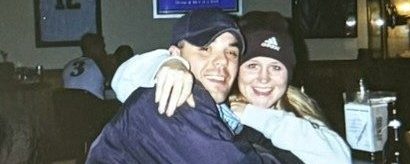
When I heard Sloan had passed, I glitched.
That’s honestly the best word I’ve found for it. Not because I didn’t feel anything. Because I felt everything.
At once.
Twenty years collapsed into a single moment and my brain didn’t know where to start. Yet when I heard he was gone, it felt like I had talked to him yesterday. That didn’t make any sense to me.
What made even less sense was how deep the grief felt.
I expected to be sad. Somebody who had been important to my life had died. Of course I was going to be sad.
But this felt different.
The best way I can describe it was like someone dumped a jewelry box full of tangled chains into my lap and asked me to find the beginning. Every time I reached for one thread, ten more appeared. Every memory was attached to another memory. Every thought was attached to another thought. Every realization seemed connected to ten others. I wasn’t crying. I wasn’t falling apart. I wasn’t even able to explain what I was feeling. I was just… glitching.
Because somewhere inside that knot was Sloan.
At least that’s where I thought the knot ended.
The more I pulled on it, the more I realized it didn’t end there at all.
That’s what kept throwing me.
I’d grab a thread that felt connected to Sloan and somehow end up somewhere completely different.
One minute I was thinking about Korea. The next minute I was thinking about a conversation. Then I’d remember a case. Then something from years later would show up out of nowhere and I’d find myself sitting there wondering why the hell my brain had connected those two things.
Except it wasn’t just those two things.
Everything seemed connected.
That’s what made it so hard to explain.
Nothing was staying in its lane.
Sloan wasn’t just Sloan.
Korea wasn’t just Korea.
Investigations weren’t just investigations.
Every time I thought I had found the edge of something, another piece would appear attached to it.
It was like pulling one chain out of the jewelry box only to discover it wasn’t one chain at all. It was ten chains twisted together so tightly that I couldn’t tell where one ended and another began.
The farther I followed it, the harder it became to tell the difference between a memory, a lesson, an experience, or a piece of myself.
I’d remember Sloan and suddenly I’d be looking at the way I approach a problem.
I’d remember a case and somehow end up thinking about a conversation I had twenty years later.
I’d remember Korea and find myself staring at patterns that have followed me through almost every chapter of my life.
That is where I kept getting stuck, because Korea wasn’t the start of those patterns. I was already trained long before Sloan ever knocked on my dorm room door. Childhood had already taught me how to read a room, watch people’s faces, listen to what wasn’t being said, notice shifts in energy, predict what might happen next, and adjust before anyone else even realized something had changed.
I didn’t know that’s what I was doing back then. I wasn’t walking around with language for it. I wasn’t calling it pattern recognition. I wasn’t calling it systems thinking. I wasn’t calling it anything. It was just how I survived. It was normal to me because it had always been normal to me.
Then I got to Korea, and Sloan stepped into that part of my life.
At the time, I thought I was just living. I was young. I was in the military. I was figuring things out as I went. Life was moving fast, the way life does when you’re in it and not standing outside of it trying to understand every layer. I wasn’t looking for a lesson. I wasn’t trying to become anything. I wasn’t thinking about how this chapter would matter twenty years later. I was just living my life.
What I can see now, while processing his death, is that Sloan was able to become such a pillar because he didn’t have to create anything in me. It was already there. He saw it, took it seriously, and gave it a place to go. He took what childhood had trained into me for survival and helped shape it into something I could use with purpose.
That is the part that feels so big now.
I thought this was about investigations.
Then I realized investigations was only the place where it happened.
What Sloan really gave me was the golden key.
Not a key to one door.
Not a key to one job.
A key that worked in every system I touched after that. Military systems. Corporate systems. Relationship systems. Family systems. Human systems. Life systems.
That key was already made from pieces of me, but Sloan helped put it in my hand. He helped me understand how to use it before I even knew how important it would become.
And I don’t think little Korea Jill had any clue.
She was too busy living at ninety miles an hour, like most people do. She was learning the job, chasing cases, going on town patrol, eating Miss Kim’s burgers, making memories, having adventures, and moving through life without stopping every five seconds to ask, “What does this mean? How will this shape me? Why does this person matter?”
She was just living.
Now, twenty years later, I am sitting with his death and realizing the size of what he gave me. I knew Sloan mattered. I knew Korea mattered. I knew that chapter mattered. But I did not understand how much of a pillar he had been until I started processing him being gone.
That is what keeps hitting me.
Not in one clean moment.
Not like some dramatic movie scene.
More like each chain I lift from the jewelry box shows me another place where Sloan’s impact still exists. Another place where that golden key opened a door. Another place where something he saw in me kept growing long after both of us left Korea.
And the grief gets deeper because the picture keeps getting bigger.
The bigger picture was Sloan.
Not Sloan as one memory. Not Sloan as Korea. Not Sloan as investigations. Not Sloan as one person from one chapter of my life. Sloan as a pillar I had been leaning on for twenty years without understanding how much weight that pillar had actually been holding.
That is the part I could not stop staring at.
Because the more I pulled from that jewelry box, the more I realized I had been looking at Sloan too flat. Like he belonged to one place, one time, one version of me. Korea Sloan. Investigations Sloan. Senior Airman Jill Sloan. The Sloan who knocked on my dorm room door. The Sloan attached to cases, town patrol, Miss Kim’s burgers, phone calls, and stories.
All of that was true.
It just wasn’t big enough.
Because even those versions still kept Sloan inside the edges of memory. They kept him attached to the parts of my life I could name easily: Korea, investigations, town patrol, cases, Miss Kim’s burgers, phone calls, and stories. Those were real, but they were also the surface pieces. They were the pieces I already knew how to hold.
What I was starting to see was different.
Sloan was not only attached to what happened back then. He was attached to what kept happening after. That is the part that made everything feel heavier. The more I looked at what he gave me, the more I could see it moving through places that had nothing to do with Korea anymore. It showed up in the way I read people. It showed up in the way I move through systems. It showed up in the way I keep asking questions when something does not feel right. It showed up in the way I can look at a room, a process, a relationship, or an entire program and feel where the pressure points are before anyone has explained them.
Those patterns were already in me, but they had not started as strengths.
They had been shaped by a childhood system I had to survive. I learned how to read a room because I had to. I learned how to watch faces, listen underneath words, notice shifts in energy, predict what might happen next, and adjust before anyone else realized something had changed because that was how I stayed ahead of chaos.
So no, Sloan did not create those parts of me.
But he changed what they could become.
He was an alchemist.
He took something that had been shaped inside a toxic system and helped transform it into something I could use with purpose. What had once been survival became investigation. What had once been hypervigilance became awareness. What had once been reading danger became reading systems. What had once been me trying to make sense of chaos became a golden key I could use in any system I walked into.
That is the part I could not stop staring at.
The key did not only work in investigations. That would have made sense. That would have kept Sloan inside Korea where I had always known how to find him. But the more I sat with his death, the more I could see that the key had followed me everywhere. It showed up in the military when I had to read people, systems, rank, silence, ego, fear, and the things nobody said out loud. It showed up in corporate security when I walked into programs that were messy, disconnected, or half-built and could feel where the pressure points were before anyone explained them. It showed up in relationships when words did not match behavior. It showed up in family systems when patterns repeated with different faces. It showed up in the way I move through life, always looking underneath the surface because the surface is rarely where the truth lives.
That is what made Sloan bigger than the memory.
He was not just attached to the place where the key first made sense. He was attached to the moment the key changed form. That is the piece I had not understood before. I had been carrying something shaped by survival long before I met him, but Sloan helped transform it into something I could use without staying trapped inside the system that created it. He helped turn the part of me that had to watch everything into the part of me that could understand anything. He helped give purpose to something that had only known protection.
There is a quiet kind of grief in realizing that.
Not dramatic. Not loud. Not falling-apart grief. Something deeper and heavier than that.
Because now I can see it.
I can see the childhood system. I can see Korea. I can see Sloan. I can see investigations. I can see the golden key. I can see how that key moved through every system after that. I can see how something born from chaos became one of the most useful parts of how I exist in the world.
And it is sad because he will never get to experience it.
Not because I know what “it” would have been for him.
I don’t.
That is part of why it feels so heavy.
I do not know what question would have opened the next door. I do not know what piece of his life would have connected to something he had never connected before. I do not know what part of his own story would have shifted if he had been able to see it from farther away. I do not know what would have made him stop and realize that something he thought he understood was only one layer of something much bigger.
I just know there was more.
There had to be more.
That is what this whole process has shown me. Not that I have answers. Not that I can define every chain in the jewelry box. Not that I can make sense of all of it just because I can finally see more of it. If anything, the more I see, the more I understand how much I could not have seen before.
That is the part I wish Sloan could have experienced.
The opening.
The widening.
The moment when the thing you thought you understood suddenly becomes bigger than the version you had been carrying.
Whatever that would have been for him, he deserved to see it.
He deserved to feel the world open in that way.
He deserved to have his own moment of looking at the pieces of his life and seeing something new in the way they connected.
That is the sadness I keep coming back to.
The man who helped transform something in me will never get to experience what that kind of transformation could have opened in him. The man who helped me find a golden key I could carry into any system will never get to feel whatever his own version of that could have become.
I do not know what that would have looked like for Sloan.
I do not want to pretend I do.
That is what makes it feel so big. I cannot name it for him. I cannot define it. I cannot wrap it up neatly and say, “This is what he missed.” That would make it too small, and it was not small. It was the unknown. The unpulled chain. The unopened door. The part of the picture that only appears after enough life, enough distance, enough questions, and enough honesty finally bring it into view.
Maybe it would have been a realization. Maybe it would have been a question. Maybe it would have been a moment so ordinary from the outside that no one else would have understood why it mattered. Maybe it would have been something that made him stop in the middle of his own life and see one piece connect to another piece in a way it never had before.
I do not know.
I just know he deserved the chance to experience it.
He deserved the chance to feel his own world open wider. He deserved the chance to see something he thought he understood become larger than the version he had been carrying. He deserved the chance to find whatever was still waiting on the other side of the next question, the next fear, the next loop, the next story he had told himself because it was the only version he had at the time.
That is the part that sits so heavy.
Not just that Sloan is gone.
Not just that I miss him.
Not just that I am finally understanding the size of what he helped transform in me.
It is knowing that the man who helped turn my survival into a golden key will never get to experience whatever key was still waiting inside his own story.
He never got to see it.
And somehow, that is the chain I still do not know how to put down.
Maybe the only thing left to say is that I am glad I got to be there. In Korea, in that office, in that version of my life, with Sloan standing there before either of us knew how far any of it would reach. It hurts that he never got to see it, but I am glad I finally can. Not all of it, not the whole thing, not some perfectly untangled version of it, but enough to understand why his loss felt so much bigger than I expected. Sloan was one of the people who changed the shape of my life, and I will never look at that key the same way again.

 Mirror Of Chaos
Leave a comment